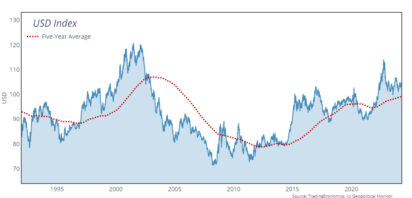
A standard of the post-Cold War global financial system has been the US dollar’s unrivaled status as preeminent global reserve currency, a role that stems from its ample liquidity and its usage in cross-border transactions for various commodities, namely oil. The resulting demand for US dollars represents certain advantages for the United States, such as cheap and easy financing for Washington, even when economic fundamentals don’t necessarily merit it. The dollar’s hegemonic position has also frequently been weaponized in the form of sanctions targeting hostile regimes from Russia to Venezuela, in order to achieve US foreign policy goals.
Yet as the United States’ hegemonic position has eroded in recent decades, new questions have emerged concerning the greenback’s enduring status as global reserve currency. Ironically, these two aforementioned advantages are contributing to the doubts, with Washington’s insatiable debt appetite giving pause to would-be buyers, and others mulling de-dollarization following years of being on the receiving end of punitive sanctions. In addition, new alternatives such as the euro and, to a lesser degree due to its strict capital controls, the renminbi are slowly eating into the US dollar’s share of the reserve portfolios of central banks around the world.
But slow is the key word here. While the US dollar is now coming down to earth as other global economies assert themselves, there’s still a long way to go before would-be challengers can match the present utility of the greenback in global trade.
Analysis
A slow but steady march toward monetary multipolarity
On a macro level, two trends have been eroding the USD’s proportion of global reserve holdings since the fall of the Soviet Union. First is the introduction of the euro in 1999, and later the renminbi’s inclusion in the IMF’s basket of SDR currencies in 2016, which granted it official reserve status. Both currencies have slowly been taken up in foreign reserve portfolios as they have expanded their share of international trade, with the euro enjoying a considerable head start over the renminbi. It should be noted here that the euro enjoys a sizable advantage over the renminbi in terms of cross-border payments, with 36.6% of such payments being conducted in euros in January 2021, compared to just 2.42% in renminbi (the USD accounted for 38.26% of such payments).
Back when the euro was first introduced, the US dollar accounted for 71% of central bank forex holdings worldwide. In the IMF’s most recent survey, that number dropped to 59%, a 25-year low. The proportion of euro holdings on the other hand opened at 18.12% in 1999 and, over the course of two decades, has grown to just 21.24% as of Q4 2020. The renminbi has seen a similarly modest expansion from 1.08% in 2016 to just 2.25% in Q4 2020.