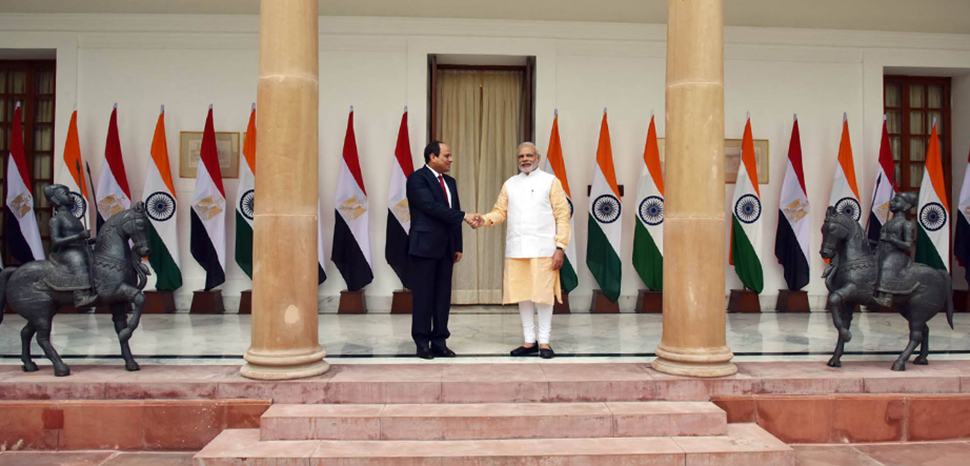
Indian Prime Minister Narendra Modi’s recent visit to Egypt signals an important moment in Indo-Egyptian relations, focusing primarily on trade and the norms of nonalignment. The visit embodies a mutual goal for strengthened political, economic, and cultural ties, leveraging the historical connections shared by both nations.
Changes in India’s and Egypt’s political landscapes have directly impacted their bilateral relations. Modi’s foreign policy has gradually matured from its “Neighborhood First Policy” in the last decade into a more nuanced and expansive portfolio of multi-lateral initiatives. Under el-Sisi, Egypt has navigated its politics carefully, focusing on domestic stability while managing expectations from various regional and international powers.
Throughout the tenures of Modi and el-Sisi, Indo-Egyptian relations have experienced significant shifts. Engagement between the two leaders is marked by mutual visits and fortification of diplomatic, cultural, security, and economic links. Two standout aspects of this relationship have been the development of trade relations and the mutual pursuit of nonalignment.
Economic and trade relations
Indo-Egyptian trade exhibits a robust and mutually advantageous trajectory. At present, bilateral trade stands at $7 billion, with hopes of boosting that figure to $12 billion over the next five years. Egypt’s strategic location and well-developed infrastructure make it a critical player in India’s broader trade ambitions in the Middle East and North Africa (MENA) region. Egypt’s economy – the third largest in Africa – presents a range of export possibilities that align well with India’s trade profile. As a crossroads between Africa, the Middle East, and Europe, Egypt offers Indian businesses a unique opportunity to access these markets efficiently.