Last month, Taiwanese President Lai Ching-te completed a highly contested visit to Africa.
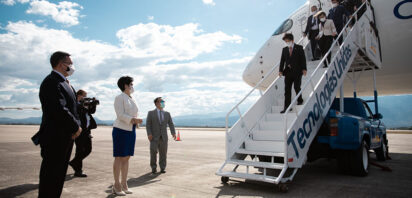
On May 3rd, Lai touched down in Eswatini (formerly Swaziland), a landlocked nation between South Africa and Mozambique, before strutting a red carpet flanked by the country’s prime minister and military guard. He later met with Eswatini’s head of state, King Mswati III, and signed a bilateral communiqué. To make the visit, Lai flew over 6,000 miles to the only African country still recognizing Taiwan diplomatically (and thus forgoing relations with China).
What made Lai’s visit notable was not the distance nor the fact that it was only his second overseas trip in two years as president. What made his travel historic, even for Taiwan’s customary diplomatic tightrope walking, was that Beijing had previously forced Lai to cancel it by pressuring Seychelles, Mauritius, and Madagascar to deny airspace for his plane. Without divulging details, Lai stated that his visit—which involved arriving unannounced after secretly boarding an Eswatini government aircraft in Taipei—occurred after “days of careful arrangements by the diplomatic and national security teams.”
On social media, Lai thanked Eswatini for “standing firm against various diplomatic and economic pressure” and “speaking out for Taiwan’s international place through concrete actions.” Meanwhile, China’s foreign ministry called Lai’s arrival a “stowaway-style escape farce” and commented, “Lai Ching-te’s despicable conduct—like a rat scurrying across the street—will inevitably be met with ridicule by the international community.”
Amid heightened cross-strait tensions and questions surrounding US defense commitments following Trump’s summit in Beijing, Lai’s African maneuver shows how Taiwan’s fight for international legitimacy is extending far beyond the Taiwan Strait, requiring creative decision-making and significant risk-taking.
Traveling Over Beijing’s Objections
Since democratizing during the Cold War’s conclusion, Taiwanese presidential visits have been a critical trigger in cross-strait tensions. Lee Teng-hui’s 1995 visit to Cornell, where he delivered a speech that prompted live-fire Chinese military exercises, established presidential travel as a provocation Beijing could not ignore.
These trips have symbolically projected Taiwan as a legitimate, sovereign, and autonomous state against Beijing’s claims that it is merely an inalienable, “renegade province” of China. Taiwan’s presidents can only formally visit countries recognizing Taiwan over China, which under the One China Principle refuses to hold formal relations with any country recognizing Taiwan diplomatically.
Additionally, these visits display notable benevolence from Taipei. As Taiwan’s remaining formal allies (down to just 12 since 2024) are largely developing countries, maintaining their diplomatic recognition has required generous developmental assistance. On these trips to Africa, Latin America, and Oceania, Taiwanese presidents take pictures at Taipei-financed hospitals, schools, and parks—including Lai in May at Eswatini’s Taiwan Industrial Innovation Park and Strategic Oil Reserve Project.
In fact, these trips often have greater value in their transit locations than final destinations. With long flights to Latin America, Taiwanese presidents have stopped in US territory to refuel, rest, and conveniently meet with top-ranking officials. In 2018, President Tsai Ing-wen had breakfast with the governor of New Mexico, lunch with three members of Congress, a call with then-Senator Marco Rubio, and a meeting with the chair of the Senate Indo-Pacific policy subcommittee—all during a one-day stopover in Los Angeles en route to Paraguay. Returning from a Central American tour five years later, she met with House Speaker Kevin McCarthy at the Reagan Presidential Library, which Beijing condemned.
Before Eswatini, Lai had only made one overseas visit as president—a week-long whirlwind tour of Pacific island-nation allies in December 2024 with transits in Hawaii and Guam, where he met with US governors and diplomats. Last July, Lai cancelled a visit to Paraguay with transits in Dallas and New York City, according to the New York Times at the Trump administration’s request to avoid upsetting Beijing.
Taiwan’s Constricted Diplomacy
Since 2017, Taiwan’s remaining diplomatic relations have dwindled. The 2008-16 Ma Ying-jeou administration of the Kuomintang (KMT) party negotiated a “diplomatic truce” with Beijing, which froze Chinese efforts to pick off Taiwan’s remaining allies, but following Tsai’s 2016 election, which returned the more nationalist Democratic People’s Party (DPP) to power, Beijing resumed its poaching. In the following seven years, Gambia, São Tome and Principe, Burkina Faso, Panama, the Dominican Republic, El Salvador, the Solomon Islands, Kiribati, Nicaragua, and Honduras all ended formal ties with Taiwan and established relations with China—receiving trade agreements, infrastructure projects, and bountiful state gifts in return.
Two days after Lai’s election in January 2024, Beijing announced relations with Pacific island-nation Nauru, dropping Taiwan’s formal ally count to just twelve.
What this means for Taiwan is that its ability to project legitimacy abroad has weakened, losing several embassies as well as allies that would conduct bilateral state visits and lobby for Taiwan’s inclusion to international fora, like the World Health Organization (WHO) where Beijing has pressured countries to exclude it.
Washington has backed Taipei’s struggle, particularly in Latin America. Since 2017, consecutive US administrations have sought to preserve Taiwan’s remaining relations there as part of a broader strategy to curb China’s rising influence. Following the Dominican Republic and El Salvador switching in 2018, the White House condemned China’s “political interference in the Western Hemisphere.” The following year, Secretary of State Mike Pompeo visited Paraguay to signal US support. In March 2020, Trump signed the Taiwan Allies International Protection and Enhancement Initiative (TAIPEI) Act, which commits the US government to support Taiwan’s diplomatic standing and codifies “altering” relations with countries that “undermine the security or prosperity of Taiwan.”
One of Taiwan’s strongest advocates has been Marco Rubio. As Senator in 2018, he threatened to cut aid to Guatemala if it switched; as Secretary of State in 2025, he thanked Guatemala’s president for not switching and announced visa cancellations for China-connected Central American citizens.
Notwithstanding Washington’s support, Taipei faces formidable competition from Beijing. The Belt and Road Initiative has dramatically grown China’s reputation as a source of beneficial infrastructure projects, even amid debt-related concerns and criticism. During the pandemic, China emerged as a global humanitarian behemoth, and it remains a crucial source of capital and commerce for countries worldwide despite internal economic woes.
China does not only use carrots. Days after Guatemala’s president held a virtual meeting with Lai in 2024, Beijing cancelled Guatemalan coffee and macadamia shipments. Toward Paraguay, Beijing has withheld COVID equipment donations, sent an envoy to lobby for switching relations (who Paraguay’s government promptly expelled), and gifted several dozen Paraguayan journalists and politicians all-expenses-paid trips to China with implicit reciprocity.
When Lai arrived in Eswatini last month, China cancelled tariffs for all African countries—except Eswatini. That same day, China forced the cancellation of one of the world’s largest human rights conferences in nearby Zambia after its organizers refused to ban Taiwanese delegates.
The State Department commented on China’s pressure: “Taiwan is a trusted and capable partner of the United States and many others, and its relationships around the world provide significant benefits to the citizens of those countries, including Eswatini… this travel is routine and should not be politicized.”
Florida Senator Rick Scott was blunter: “Communist China’s stunt to intimidate Taiwan FAILED,” he tweeted. “I’m glad to see that President Lai Ching-te touched down safely in Eswatini. Freedom WILL prevail.” Referencing Germany and the Czech Republic reportedly refusing Lai a transit stop, the post continued: “To the SPINELESS world leaders across Europe and elsewhere who caved to Communist China, the world took note. America won’t forget.” Evidently, Lai’s ability to conduct diplomacy abroad is not lost on Taiwan’s advocates in the United States.
To Eswatini and Beyond
Lai’s contentious visit also coincides with domestic turbulence in Taiwan. Facing a fractured legislature frustrating domestic policy, Lai failed to recall opposition lawmakers and saw his approval rating sink to 33% last summer. Fistfights are not uncommon in Taiwan’s parliament. In April, the opposition KMT party leader met with Xi in Beijing, a move that supporters justified as pragmatism and critics lambasted as treason.
Despite a strong tech-driven economy, Taiwan’s government struggles to justify the $500-million annual budget of the International Cooperation and Development Fund, its USAID-like overseas developmental assistance agency. Even advocates for formal relations find it hard to defend financing small nations offering no military support that the United States, Japan, and other regional powers could provide during a Chinese attack.
Moreover, this threat continues to loom large. Xi has reportedly ordered China’s top brass to be prepared to take Taiwan by force by the end of next year, and his continued purging of top-ranking generals suggests he tolerates no internal opposition. In December, China conducted its largest military exercises around Taiwan to date following a US arms deal to the island. Lai continues promoting “whole-of-society defense resilience” to prepare citizens to withstand an invasion, blockade, or other “gray-zone” coercion that Xi could launch.
Trump, meanwhile, has implored Taiwan to raise defense spending to 10% of GDP, levied tariffs on the island, and raised fears of weakened US defense commitments during his visit to China amid an unresolved war with Iran. Since returning, he has held up a $14 billion arms sale to Taiwan, which he discussed with Xi in Beijing. Comments by Secretary of Defense Pete Hegseth at the Shangri-La Dialogue in Singapore last month did not allay fears, as he stated any arms sales “will depend on the president and the nature of [the US-China] relationship.”
With 90% of the most advanced semiconductors still produced exclusively on the island, the “silicon shield” continues to be perhaps Taiwan’s strongest deterrent. But when considering all efforts to create a “boiling moat” or “porcupine” for Beijing, maintaining international allies—as small and as few as they are—that speak in support of Taiwan on the world stage (as Belize does every year at the United Nations General Assembly) remains a form of Taipei’s defensive ammunition.
Although Lai made it to Eswatini and hosted Paraguay’s president in Taipei the following week, the fact that African nations denied him airspace and that he had to travel unannounced shows that Taiwan’s limited diplomatic leeway is shrinking even further. To continue making these visits—especially more contentious ones to Latin America with US stopovers—Lai will need to remain ever nimble and creative to dodge Beijing’s pressure campaign.