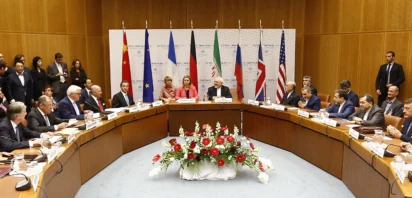
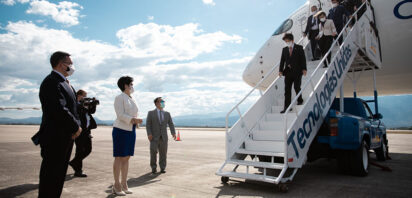
In late March 2026, a bipartisan Senate delegation led by Senators Jeanne Shaheen and John Curtis arrived in Taipei alongside Thom Tillis and Jacky Rosen, reaffirming Washington’s commitment to Taiwan amid intensifying Chinese gray-zone coercion and a deepening legislative deadlock in Taipei over defense spending.
The visit attracted little surprises in Washington. That, in itself, was revealing. In an era when bipartisan agreement on consequential foreign policy questions has become the exception rather than the rule, support for Taiwan endures as one of the few constants. Yet that endurance should not be mistaken for strategic sufficiency.
The central argument of this analysis is stated plainly at the outset: bipartisan senatorial support for Taiwan is symbolically potent in sustaining policy continuity and signaling commitment, but it is materially constrained by implementation failures, structurally complicated by a widening gap between congressional and executive messaging, and strategically bounded by Taiwanese domestic politics, rising public skepticism, and the escalation dynamics of US-China rivalry.
The result is an increasingly visible distance between political symbolism and operational credibility and understanding that gap requires examining not only how the consensus was built, but why it is no longer self-sufficient.
From Containment Logic to Institutional Anchor
Congressional support for Taiwan did not begin as democratic solidarity. Its earliest foundations lay in Cold War containment and the domestic politics of anti-communism, cemented by the 1954 Mutual Defense Treaty and the Formosa Resolution. The Taiwan Relations Act of 1979 (TRA) represented the decisive transformation.
Passed after President Carter’s unilateral recognition of the People’s Republic of China (PRC) triggered a significant legislative backlash, the TRA established the legal framework for unofficial relations, mandated defensive arms provision, and declared that any non-peaceful resolution of Taiwan’s status would be of grave concern to the United States. Congress had asserted, emphatically, that Taiwan policy would not rest on executive discretion alone.
That statutory anchor proved durable across administrations of sharply different orientations. As Taiwan democratized, abolishing martial law in 1987 and inaugurating direct presidential elections in 1996, congressional support acquired a second justification rooted in democratic solidarity rather than anti-communist logic alone. By the 2000s, the Senate Taiwan Caucus had become a permanent legislative platform, Taiwan-related bills proliferated with bipartisan co-sponsorship rates regularly exceeding 85 percent, and congressional pressure on arms sales and executive engagement with Taipei had become structurally embedded in Washington’s Indo-Pacific posture.
Why the Consensus Endures
The durability of senatorial support reflects a convergence of strategic, institutional, and political incentives that remains unusually robust. Taiwan occupies a pivotal position in the first island chain and anchors regional military balance calculations for national security hawks.
Its dominance in advanced semiconductor manufacturing renders its security a matter of industrial and technological priority for economic strategists. And for liberal internationalists, Taiwan embodies democratic governance persisting under sustained authoritarian pressure. Few foreign policy questions unite these arguments so neatly or generate so little domestic political cost in the supporting.
Supporting Taiwan also allows senators to demonstrate foreign policy seriousness and toughness on China without immediately confronting the domestic risks associated with military intervention.
Unlike debates over Ukraine, the Middle East, or immigration, Taiwan remains largely insulated from direct partisan polarization. High-profile delegations and Taiwan caucus leadership provide senators opportunities to build foreign policy credentials and national visibility.
This structural alignment of principle, ambition, and geopolitical signaling helps explain why the consensus has proven so resistant to erosion across electoral cycles.
The Executive-Congressional Gap
Bipartisan consensus obscures a growing divergence between congressional and executive messaging on Taiwan. This dimension is often underexamined, yet by 2025 and 2026 it has become central to understanding the limits of US signaling.
The second Trump administration has approached Taiwan with a more transactional logic that sits uneasily alongside congressional assertiveness. In April 2025, President Trump imposed a 32 percent tariff on Taiwanese imports, exceeding those applied to Japan and South Korea, while accusing Taiwan of having “stolen” the US semiconductor industry. Treasury Secretary Scott Bessent framed Taiwan’s concentration of advanced chip production as a systemic risk to the global economy rather than a source of deterrence.
Reports indicated that a tranche of arms assistance was paused to preserve negotiating flexibility ahead of a planned summit with Xi Jinping. In January 2026, the president suggested that Taiwan’s status was ultimately for Beijing to decide, adding only that he would be “very unhappy” if force were used. The administration’s refusal to grant President Lai a transit stop in New York later that year marked a further departure from established practice.
Congress has moved in the opposite direction. The Porcupine Act, passed by the Senate in December 2025, sought to accelerate arms transfers by elevating Taiwan’s standing within export control frameworks. The FY2026 National Defense Authorization Act expanded joint training and funding for the Taiwan Security Cooperation Initiative, even as the president signed it with reservations about constraints on executive authority. The House introduced the Six Assurances to Taiwan Act in May 2025 to raise the domestic political cost of treating Taiwan as a bargaining chip in US-China negotiations. Yet such measures have limited enforceability and do little to bind an administration determined to retain diplomatic flexibility.
This divergence raises a straightforward question: When Congress signals commitment and the White House signals contingency, which message carries greater weight in Beijing?
There is little reason to assume that Chinese decision-makers privilege the more reassuring signal. Adversaries tend to calibrate their assessments to the least reliable link in a chain of commitments. Under such conditions, congressional consensus, however visible, carries less deterrent force than it appears to at home.
Not all congressional actions carry equal weight. Routine delegations attract attention but impose few lasting constraints. Statutory provisions, drawdown authorities, and arms authorizations create more durable commitments that shape policy beyond a single administration. More ambitious legislative efforts, such as the Taiwan Policy Act in its strongest proposed form, would have approached a shift toward quasi-recognition.
The significance of congressional engagement therefore lies on a spectrum, and analyses that treat all forms of support as interchangeable overlook the differences that matter most in practice.
The US Arms Backlog
The most direct material constraint on senatorial support’s operational relevance remains the US arms delivery backlog to Taiwan, which stood at over $21 billion as of late 2025. Delivery of the 66 F-16 Block 70/72 fighters, notified to Congress in August 2019 and valued at $8 billion, has slipped repeatedly, with the first aircraft rolling off the production line only in March 2025. Joint Stand-Off Weapons face a gap of nine years between congressional notification and anticipated final delivery. Mk 48 torpedoes and MQ-9B surveillance drones face their own sequencing uncertainties.
Some of these delays reflect genuine industrial-base constraints, worsened by competing wartime demand in Europe and the Middle East and by the inherent limitations of a defense manufacturing sector not sized for simultaneous multi-theater support.
Others reflect a feedback loop within Taiwan’s own procurement system: undelivered arms reduce the justificatory basis for expanded defense budgets, because Taiwan’s independent National Audit Office monitors how approved spending is actually executed. The causes matter for diagnosis, even if the strategic effect is the same: congressional promises and arms authorizations appear increasingly detached from operational timelines, and deterrence depends not on declared intent alone but on perceived capability.
Opposition politicians in Taipei routinely cite US implementation failures to argue that Washington expects sacrifices from Taiwan while struggling to meet its own obligations.
The Semiconductor Paradox
The role of Taiwan’s semiconductor industry in US strategic calculations deserves more serious treatment than it typically receives in congressional discourse. TSMC accounts for over 90 percent of the world’s most advanced chip manufacturing at leading-edge nodes of seven nanometers and below, a concentration that renders Taiwan genuinely irreplaceable in the near term for the global electronics and artificial intelligence supply chains.
This dependence has long been described in Taipei as a “silicon shield,” the logic being that any military action against Taiwan would be economically catastrophic for the attacker and for the world alike.
The paradox, however, is that US policy is now systematically eroding that shield from the outside. The TSMC Arizona fabs, backed by $250 billion in Taiwanese technology sector investment commitments secured under January 2026 trade negotiations, represent a deliberate US effort to reduce strategic dependency on a single geographic chokepoint.
Analysts of chip geopolitics have observed that Washington’s core interest is not to protect Taiwan because of chips but to ensure access to chips regardless of what happens to Taiwan. These are fundamentally different risk calculations, and the divergence matters. If the diversification of advanced manufacturing reduces the world’s singular dependence on Taiwan, it may over time reduce the structural deterrent that Taiwan’s industrial concentration currently provides, even as US-Taiwan defense cooperation deepens. Congressional rhetoric about Taiwan’s strategic importance should grapple more honestly with this tension rather than treating semiconductor dominance as a stable and permanent asset.
Escalation Dynamics and Their Limits
Congressional delegations and rhetorical upgrades are often framed in Washington as low-cost deterrent signaling. In practice, their escalatory implications are not trivial. Beijing has repeatedly treated high-profile congressional engagement as justification for intensified military exercises and coercive patrols.
The December 2025 “Justice Mission” exercises, described as the most extensive PLA exercises around Taiwan to date, were publicly framed by Chinese state media as a direct response to the $11 billion arms sale notification of that month. This does not mean congressional action causes Chinese escalation in any simple sense; Beijing’s pressure campaign is structural and predates most contemporary legislative activism. But specific actions provide convenient pretexts for calibrated demonstrations of force, contributing to a ratcheting dynamic in which symbolic political signaling can produce immediate operational consequences.
Estimates suggest that a Taiwan conflict could erase between $2 trillion and $10 trillion in global GDP in its first year, while paralyzing the semiconductor supply chains that underpin both military and civilian technology. In that context, even symbolic actions warrant scrutiny for their escalatory implications, particularly when they are not accompanied by commensurate improvements in readiness or deterrence capacity.
Taiwan’s Domestic Filter
As much as when congressional support is strategically coherent, its practical effect is mediated through Taiwan’s own domestic politics in ways that most American analyses understate.
For the Democratic Progressive Party (DPP), bipartisan support from Washington remains a central source of political legitimacy and strategic validation. The March 2026 delegation’s explicit endorsement of President Lai’s proposed NT$1.25 trillion special defense budget offered the DPP immediate leverage in domestic budget battles, allowing it to frame expanded defense spending as aligned with allied expectations.
The oppositions Kuomintang (KMT) and Taiwan People’s Party (TPP), which together hold a legislative majority, have blocked that budget from advancing, reflecting not only fiscal conservatism but a strategic worldview that places greater value on cross-strait dialogue and a more resilient, asymmetric defense posture than the DPP favors. Historical memories of the 1979 derecognition continue to reinforce a generational caution within the KMT toward over-reliance on US commitments.
Public opinion reflects similar complexity, and it is deteriorating in ways that complicate the deterrence picture. A recent survey data found that 59.6 percent of Taiwanese respondents did not consider the United States trustworthy, a near ten-point increase from the prior year, while 40.5 percent reported holding negative views of the United States overall, up sharply from 24.2 percent in mid-2024.
Confidence in American willingness to intervene militarily in a conflict has declined correspondingly. These shifts are fueled by Trump’s tariff regime, the blocked New York transit, and concerns that TSMC’s Arizona expansion may reduce Taiwan’s strategic indispensability, a development that 疑美論, or ‘American Skepticism Theory,’ has been quick to exploit.
While the concept is amplified by PRC information operations, it further notes explicitly that it gains traction because it resonates with genuine anxieties rooted in historical experience and observable American behavior.
Academic research underscores the practical consequence: public belief in the credibility of external military assistance significantly increases willingness to fight and support for a larger defense budget. Conversely, eroding confidence in American reliability can weaken the very domestic resolve that deterrence requires. Congressional signaling may reinforce DPP supporters while deepening skepticism among KMT-leaning Taiwanese, producing a partisan filtering effect that limits its reach across the polity as a whole.
On the American side, the 2025 Chicago Council survey found that while majorities of both Americans and Taiwanese identified the United States as militarily superior to China, Americans remain notably more reluctant than Taiwanese to endorse committing US forces to a Taiwan conflict.
Deterrence rests partly on adversaries believing that elite commitments reflect durable societal resolve rather than transient political positioning. That belief is harder to sustain when polling data and presidential rhetoric point in different directions from congressional resolutions.
Closing the Gap
Nearly five decades on, the TRA remains one of the most consequential congressional interventions in US Asia policy. It preserved strategic ambiguity and established a durable baseline of support across administrations. But durability is not adequacy.
The strategic environment has moved faster than the framework built to manage it. China’s military capabilities have expanded sharply, the costs of conflict have escalated, and Taiwan’s domestic politics have grown more fragmented. At the same time, confidence in US commitments has weakened on both sides of the Pacific, while the gap between Congress and the executive has become a structural weakness in deterrence rather than a tolerable inconsistency.
Congressional consensus still matters. It reassures Taipei, signals continuity to allies, and sets a floor beneath which US policy is unlikely to fall. But it does not resolve the gap between commitment and capability.
That gap now turns on more concrete factors: whether arms deliveries accelerate, whether political signaling is aligned across branches of government, whether semiconductor strategy strengthens or dilutes deterrence, and whether Washington and Taipei can move beyond spending targets toward coordinated force development and readiness.
Bipartisan senatorial support remains a strategic asset. Its significance now lies in how much longer it can compensate for the widening distance between what is promised and what is prepared.